


Somewhere in the British Museum, there’s a drawer with a copper halfpenny in it. Minted in 1672, it’s small enough to lose down the back of a chair – and doing some of the strongest PR work in royal history.
Around the King’s head runs a short Latin legend: CAROLVS A CAROLO (Charles from Charles).
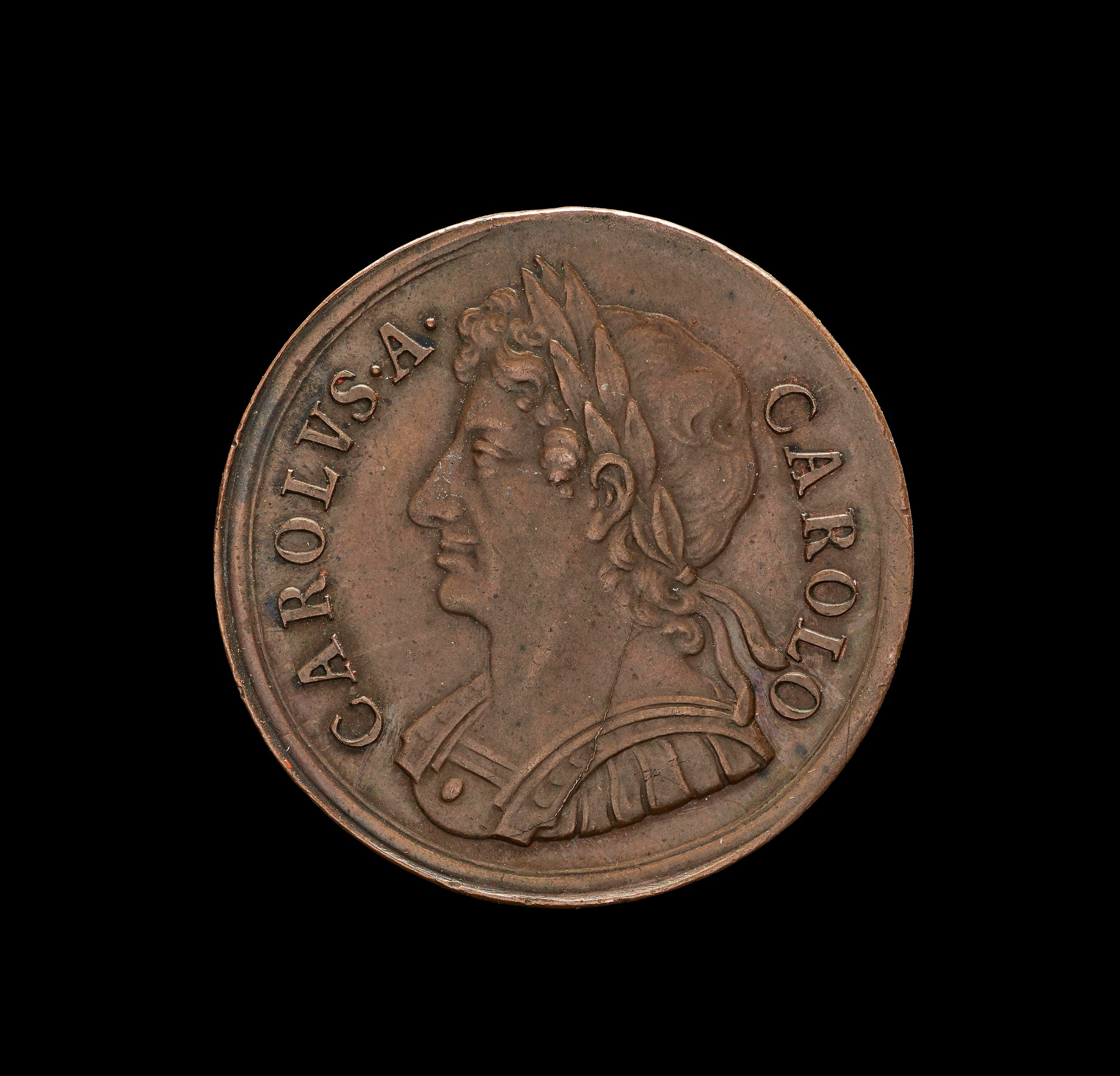
It states the obvious. Nobody in England needed telling whose son Charles II was. But the phrase wasn’t a reminder, it was an erasure. Charles after Charles — as though the second reign had simply followed the first.

If you’re new here, hello! I’m Victoria. 👋
I’ve been writing about the Royal Family and their ancestors for almost 15 years, running The Crown Chronicles for 11, and appearing on international channels as an expert commentator since 2018 — I’m also known as the Royal Expert.
My niche is joining the dots when it comes to the British Monarchy: my comms career gives me an instinct for what’s being managed behind the scenes, and my history background means I can spot when we’ve seen this story before.

No trial in Westminster Hall for dear old dad. No scaffold outside the Banqueting House with a blade and a block. No Commonwealth, no Protectorate, no Cromwell. 11 years, gone… on a coin that changed hands hourly in every corner of England.
Charles II is remembered as the Merrie Monarch: the mistresses, the return of Christmas, the spaniels with the natty hairdo. But the party was actually a strategy. He spent 25 years running what any modern PR or comms adviser would recognise on sight: message discipline, audience segmentation, and a set of symbols doing the work of a logo.
That’s my argument, and it was the subject of my master’s dissertation back in 2018. That is how, and how effectively, he rebuilt royal authority through the royal image after the Restoration.
Charles had four objectives on his return:
Secure the legitimacy of his rule through his bloodline
Win affection as well as obedience
Show he was a different man to his father
Make the memory of the republic disappear.
Sounds easy… right?!
PS… This will be a multi-part article - it’s fairly hard to distill a 20,000 word dissertation into one single Substack! So here, I assess points 1 and 2, but look out for next week’s edition!
The backdrop of the Restoration
To understand what Charles II was up against when he came back to England in 1660, you need to know what came immediately before — and in terms of reputation building, it’s worse than it initially sounds.
When it came to Kingship and reputation, the Merrie Monarch was starting on the back foot.
His father, Charles I, inherited money troubles and a firm belief in the Divine Right of Kings: the Monarch answered to God alone. Not Parliament, and certainly not his subjects.
Add a stammer that made him shy — which read to many as aloofness — and an unshakeable loyalty to the Duke of Buckingham (whose foreign policy was a run of expensive humiliations), and you had a King who could be very difficult to deal with.
When MPs moved to impeach Buckingham, Charles I dissolved Parliament and raised money by other, legally dubious means — then ruled 11 years without calling one at all. By 1642 the country was fighting itself, and in January 1649, the King was on trial. He refused to recognise the court’s authority, and lost his head.
Monarchy was abolished by statute, along with the Lords.
What followed was a series of military-backed regimes, then Cromwell as Lord Protector from 1653. The bans people hang on him — theatres closed in 1642, Christmas from 1644 — mostly predate his tenure, though he did agree with them.
The Church of England wasn’t reformed, but dismantled: bishops abolished, the Book of Common Prayer outlawed. Then Cromwell died, his son Richard lasted eight months, and 1659 dissolved into chaos thanks to the power vacuum.
By 1660, what the country wanted was not necessarily a King, but for the chaos to stop.
And, I’d argue, the world to feel calm after two decades of upheaval. It’s a feeling most of us recognise after our own ‘late troubled times’ of the pandemic…
Objective one: secure the legitimacy of his rule through his bloodline
Son of a martyr
Charles II didn’t make his father a martyr, that job was already done, and it happened very quickly after the execution — all while his son was hundreds of miles away on the continent.
The book, Eikon Basilike (Royal Portrait) was presented as Charles I’s own meditations on life and Kingship, published within days of his death. It’s unclear if he really wrote it, but enough Royalists and loyalists bought it that it went through around 35 editions in 1649 alone.
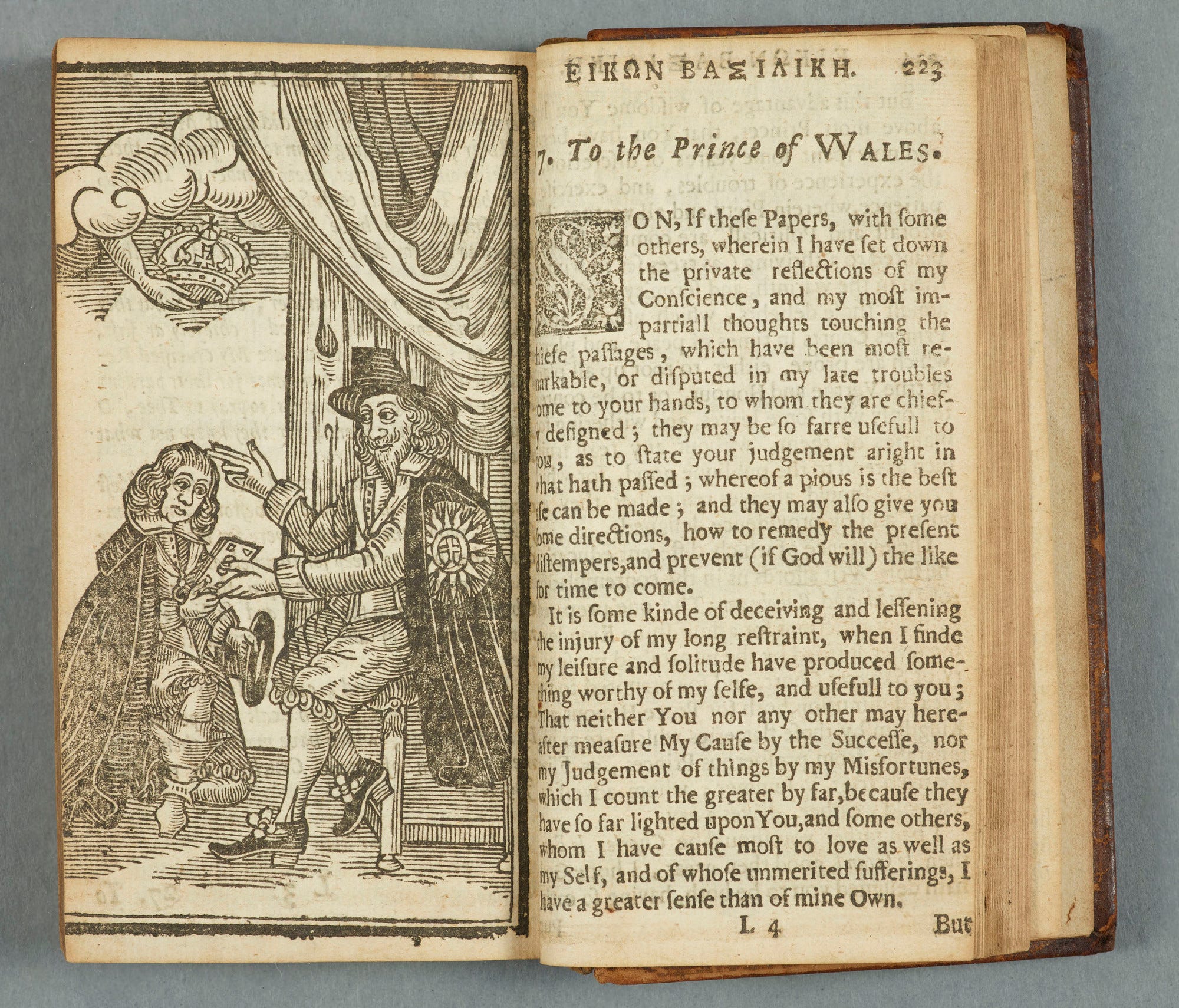
The death of Charles I had grown into a cult.
Through the Interregnum, those loyal to the Royalist cause kept 30 January quietly, read the King’s book, and treated his death as martyrdom for the true church and for Kingship, at the hands of puritans. That cult obviously ran underground for 11 years, before Charles II took it for part of his own restoration strategy: making his father’s death into something official, with a purpose.
29 May — the day he entered London, and also his birthday — was the first date to be given national significance. It was made a fixed moment in the calendar by statute (law) in 1660, as an annual day of thanksgiving.
30 January followed in 1661: a national fast day with prescribed prayers, and the year after, a specific service was added to the Book of Common Prayer for annual use.
What had been a private devotion for a committed few became a state liturgy, observed in every parish in England. Whether the congregation liked it or not…
This tells us who he was targeting: Royalists were already keeping the day, and committed Cromwellians were never going to be persuaded of his father’s martyr status. The fast day, then, reached the large, uncomfortable middle; people who’d backed Parliament in the 1640s without necessarily wanting to execute the King, and had spent a decade trying to ignore it had happened.
Being a fast day, the observance took a predictable shape, built on the familiar notion of sin. Parishioners had to acknowledge the error of executing an anointed Monarch, and feel the weight of such an unthinkable act. They had to understand the consequences of what God sent afterwards: the republic, which was recast as divine punishment.
And then came atonement, and forgiveness by their newly-returned, merciful Christian King. Who just so happened to be the martyr’s son.
Notice who’s framed as guilty here… Not the regicides, or the political and military leaders. The everyday men and women who had allowed it to happen, or at least hadn’t stood in its way.
And here’s a detail you may not have heard about before: Charles II actually dated his reign from 1649 (official documents call 1661 the 13th year of his reign, for example) but he did not take 30 January as his accession day, the date on which he actually became King.
Charles I’s death was therefore associated with the martyrdom of Jesus: executed at the hands of a baying mob. In this story, it was in the cold, bleak London winter.
But Charles II? He was the other half of that story. Returning as the people’s saviour in the springtime, to forgive their sin of the regicide. A time of rebirth, renewal and hope.
Charles created two moments in the year with two completely different emotional registers, kept carefully apart, both working for him and reminding the people of his true right to rule.
Quite a handy message to attach yourself to, non?
Interestingly, Charles was so committed to officially sanctioning the cult that he requested and had money approved for a grand monument to Charles I at Windsor, where he was interred. Sadly, it was never built, due to other pressing things that required the King’s money…
The Order of the Garter
Perhaps his smartest move was to build his legitimacy on the Order of the Garter.
It’s an institution dating back to Edward III, drawing on the mythology of King Arthur, and chivalric ideas of honour, valour and loyalty.
The Order of the Garter became one of Charles II’s earliest and most quickly-deployed strategies in 1660 — before he’d even got back to London!
George Monck, a General in the army and the man who actually made the Restoration happen, was made a Knight of the Garter shortly after Charles arrived in England, probably at Canterbury; it came a few days before his triumphant arrival into the capital.
The Order was formally reconstituted in the run-up to his coronation, and the coronation itself was held on 23 April: St George’s Day. If you’re drawing a parallel between yourself and the dragon-slaying patron saint of England, you may as well do it on his feast day.
And the use of the dragon had form: Royalists had used it during the Interregnum as a symbol for the Commonwealth itself.
The symbols of the Garter were made very visible in official portraits of the King. Featuring the insignia wasn’t new, certainly, but what was, was how few references there were to the crown, orb and sceptre — the traditional symbols of Kingship in royal portraiture.
During my research, I found 20 distinct, original portraits of the Restoration King after 1660 across various databases. 12 of them, that is 60%, featured the Garter insignia: the sash, the collar, the lesser St George.


The Garter was something Charles I had taken great pride in too, using its visuals frequently. This will have helped remind people of the new King’s legitimate ancestry and right to rule.
There was a useful ancestor attached to the Garter too, of course: Edward III founded the order back in the mid 1300s. A King who took the throne at 14 after his own father was deposed and murdered, and who rebuilt royal authority from a catastrophic position, you can see the appeal for Charles II and his own reign.
The King also used Windsor Castle more frequently — the spiritual headquarters of the Order, and the resting place of his father — to showcase Monarchy.
Charles undertook extensive works on the castle, begun in 1674. Expanding the north terrace, he stuck a rather in-your-face 12-foot Garter star onto the side of the new block, giving it the nickname the ‘Star Building’.
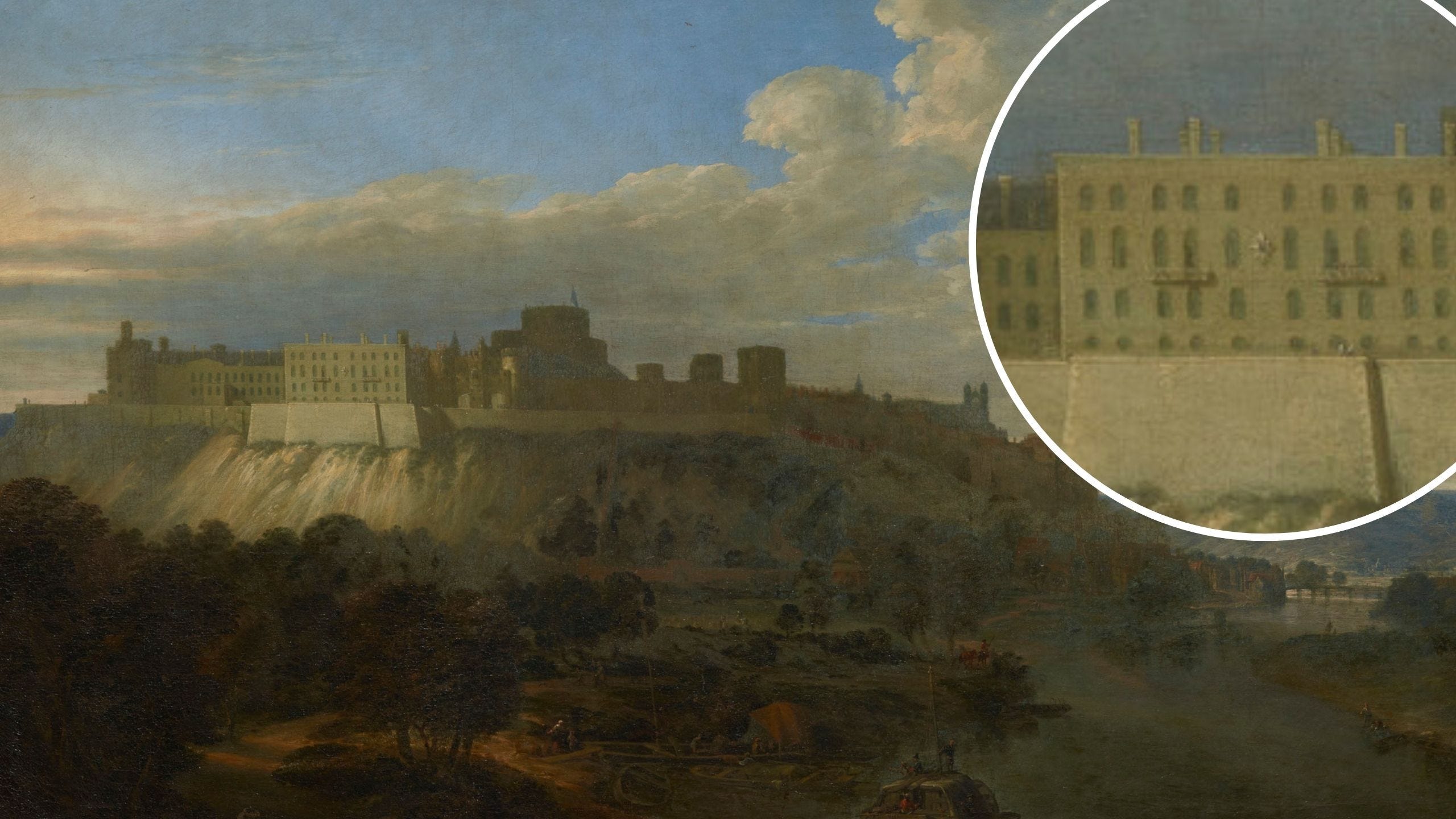
He also remodelled his chapel and the medieval St George’s Hall, with interiors featuring plenty of Garter stars, visuals of St George and the dragon, and putti holding the Order’s motto: ‘Honi soit qui mal y pense’.
That it took almost 15 years to begin these works tells us it was important but not urgent. Other, more easily-obtainable means to deploy the Garter were available (the portraits, for instance), but it was important to use consistently. Especially as relations with Parliament had begun to get tricky by that point.
Dr Anna Keay, appointed to write the official biography of Elizabeth II, makes an additional point: Charles’ right to the throne, given the events of recent decades, was contestable. Indeed it had been contested, at length — with cannon, bayonets and guns.
But his standing as Sovereign of the Order wasn’t disputed in the same way. It was, from a PR perspective, ground he would struggle to lose on.
In 1672, he backed Elias Ashmole’s enormous book on the Order: hundreds of pages, hundreds of engravings, much of it in Latin and French. Not meant for the everyday fellow. Neither was the half-crown produced in 1662 — about two days’ wages for a skilled tradesman - which bore the Garter star at its centre, flanked by the interlocked C cypher of the King’s and the badges of the four Kingdoms (England was still trying to claim France…). Check out an image here.
There’s a tell in the timing, too. Garter visibility increases after 1667, following plague, Fire and the Dutch sailing up the Medway in humiliating defeat for the English navy: three devastating catastrophes in consecutive years.
So naturally, there were fireworks (for all to see around Windsor) for the King of Sweden’s admission in 1668, plus two Garter publications in 1671 and 1672.
When the news was bad, Charles turned up the dial on the pageantry. A helpful reminder of the good parts of Kingship, of his legitimacy as Charles I’s son, and of his association with those chivalric traits.
The healing hands
And then there were his hands.
Touching for the King’s Evil — scrofula, a form of TB — had been practised on and off since the 13th century, but Charles II made it central to the royal calendar.
Touching — where the Monarch literally touched a sufferer, often on the sores on their neck — was believed to cure the disease. Because only God’s true representative can heal.
He’d even been touching in exile on the continent, including some 300 people before he left the Dutch mainland to come to England. A public reminder of his legitimacy… Even without a throne of his own.
Charles II touched some 97,000 people across his reign; cumulatively, that’s equivalent to around 2% of the population. That really is quite a feat.
Ceremonies ran for hours, with 200 people seen at a time, the same prayer and scripture repeated over and over and over.
Demand was so high for touching ceremonies that extra days had to be added to the calendar. That shows people believed in the cure — and implicitly, in his right to rule.
Everyone who attended a ceremony and was touched received what is called a touch-piece: a small coin-like token of gold, showing St Michael slaying Satan. Charles II chose this design as it was the same as his father had used.
More importantly, it was the same design as Henry VII and Henry VIII before that.
This is noteworthy, because you’ll remember that Henry VII won his crown on a battlefield, with a thin claim through his bloodline. The first Tudor King appears to have touched more often than his predecessors and the frequency of ceremonies tracks insecurity, for both Kings, showing a use of the ritual to prop up their legitimacy and power.
Objective two: win affection as well as obedience
Charles II used different campaigns and different materials, largely aimed at everybody the Garter wasn’t for.
Much of it was simply giving things back — and this was about loyalty as much as goodwill.
He gave his people Christmas, maypoles, the theatres, and pageantry again. Fun and pleasure, in essence.
Charles I had taken Garter Day ceremonies inside Windsor Castle, away from the public at Whitehall, but his son pushed them back out and let people watch. Small crowds, but it spread the word of this pageantry’s return, and showed him to be the antidote to the restrained world of the Interregnum.
For the upper levels of society, he made loyalty work harder, and he even put a price tag on it.
The proposed ‘most Illustrious Order of the Royall Oake’ was drawn up to thank those who had been loyal to Charles II and to his father. The order would have had 270 members across three ranks, with fees of £20,000, £5,000 and £2,500 at each level, which would have brought in £1.15 million for the profligate royal spender. This would have been around the same amount Parliament would have granted him for a year of spending, quite the sum.
Great Masters, the top tier, would also have had to maintain 60 horsemen each at their own expense, so it doubled as a private cavalry… Important for a man who had previously had to try to defend his position through force. In exchange, these Great Masters got tax exemptions, release from the necessity of serving in local office (e.g. as a Sheriff), and a title.
The Royal Oak was a loyalty scheme, a fundraiser and a standing army in one. Sadly for Charles, it never launched.
Returning to the Garter briefly: for the elite, the reconstitution of the Order was a reminder that it was Charles who had brought back the privileged old world order and the ways of aristocratic entitlement. Gently prodding at their insecurity — that the social order returned and rested with him — gave them a reason to be loyal to the Crown.
It would have been remiss of Charles not to thank his loyal followers and fighters, and of course he did: 159 loyalist officers were given pensions or lump sums, 70 got land, and 30 families received support after losing someone in the Royalist cause. Not groundbreaking, but important that he showed his gratitude.
Rather too readily, in fact. His Lord Treasurer, the Earl of Southampton, had to beg Charles to be ‘less benevolent’ in his rewards.
Something genuinely new he brought to the Monarchy of the Restoration was access.
In the early months of the Restoration, orders were issued that nobody wanting to see the King should be turned away from the palace.
This was big. Getting through the gates at Whitehall had previously depended on status, signalled and policed by your dress; while the old sumptuary laws had gone by the 1660s, the conventions they left behind hadn’t. Charles chose to open up the gates and let his people see him.
The King also walked freely in St James’s Park and let people approach him - yes, really! He went to the theatre and the races, mingling with his people.
After a decade of military government laying down rules and taking away the fun parts of life, a King you could physically walk up to and talk to was a striking proposition. Not to mention his 6ft 2" stature, bolstered by those oh-so-fashionable heels.
He also told stories, and he had a very good one thanks to his escape after Worcester in 1651 — six weeks on the run, hiding in the now-famous oak at Boscobel House, the disguises, the near misses.
Charles II told the story aboard the ship home and reportedly had Samuel Pepys, who had sailed with him, close to tears with the detail about his feet being too sore to stand. Note what he chose — not the battle, not bravery, but sore feet and bad shoes.
This story went out in print, in broadsides and in ballads for people who couldn’t afford books, and became the most reproduced story of the reign, embellished by others with elements of divine providence.
The oak became his. Not just a detail in the story, but the single symbol most identified with him. It was his ‘personal iconography of power’, as one historian puts it. And he leaned into it hard.
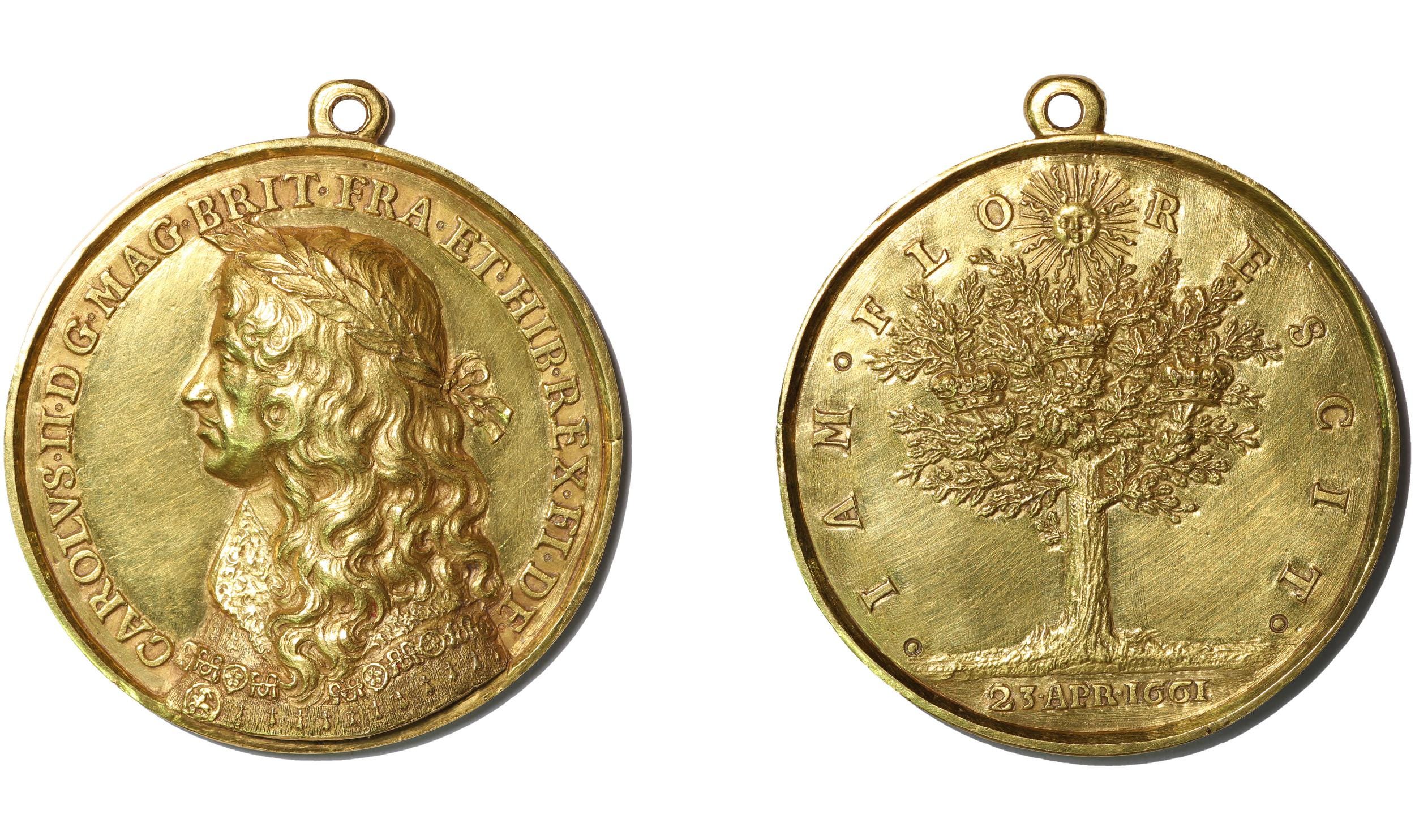
When the Order of the Royal Oak was being planned, Thomas Simon was commissioned to produce a medal for it. On the front, the King is laureate (wearing a wreath of laurels) and facing left, his trademark curls falling over his shoulder. We see a ruffed collar, ermine robes, and the collar and badge of the Order of the Garter.
On the reverse, there’s a large, leafy oak bearing three crowns (one for each of his kingdoms) with the sun beaming down on it. A tree he’d once hidden in, now holding up three crowns, with the motto ‘Now it flourishes’ (Iam Floerscit). Subtle? Nope. It didn’t need to be, he wanted it to be loud.
But what about those who had fought against him?
A canny move, indeed. Cromwell’s soldiers had their arrears paid, regiments were disbanded, and the men were helped into civilian work. The King also made sure his Privy Council (think advisory board) held mixed loyalties to represent a cross-section of the country: 16 Royalists, four former Cromwellians, and eight men who had fought against his father.
That wasn’t erasure, it was public acknowledgement. And it’s pretty cold: buying off the opposition, and deciding that absorbing your enemies beats punishing them.
So far, so successful. He had the bloodline, the saint, the healing hands, and a country broadly pleased to have its annual celebrations back.
But there was a bigger problem underneath all of it: the last King had been executed by his own subjects for behaving like a tyrant — and Charles II looked like him and was descended from him…